Rants and raves about stuff happening in and around my life in Singapore

Showing posts with label Pagan. Show all posts

Sunday, March 31, 2024

Celebrating Easter

Ostara is a Pagan solar holiday honouring the spring's warmth, light from the sun, and the awakening of the earth.  It symbolises fertility, rebirth, and renewal. This time of year marked the beginning of the agricultural cycle, and farmers would start planting seeds.The word Ostara comes from the Anglo-Saxon goddess name, Eostre. 


Eostre represented spring and new beginnings and linguistically, Eostre is the etymological origin for “Easter”. As Christianity spread through Northern Europe and with people still maintaining these older traditions, the Church, in an attempt to replace these pagan traditions and festivals with their own, started to encompass them within the Christian calendar.

Many of the symbols of Easter have roots in these traditions, and the use of rabbits and hares is one such example. In medieval times in Europe, the March hare was seen as a fertility symbol, and a sign of spring. This species of rabbit is nocturnal most of the year, but in March, it is mating season for the animal. During mating season, March hares are seen all day long. Additionally, females of this species can get pregnant with a second litter while pregnant with their first litter. This explains why they were used as symbols for fertility.

And of course, there is the pagan custom surrounding eggs. Full of promise and new life, the egg represents the fertility of the Earth and all creation. The Yolk symbolises the sun god, and the white the goddess Eostre, in perfect balance with the potential of growth. Images of hares and even painted eggs would be displayed to honour the Goddess of fertility. 

So if you are wondering why the bunny rabbit and painted eggs are still part of the celebration of Easter today now you know why. It's got sbsolutely nothing to do with Christianity and everything to do with the Pagan traditions that are still very much alive today.


Sunday, November 06, 2022

Celebrating Halloween

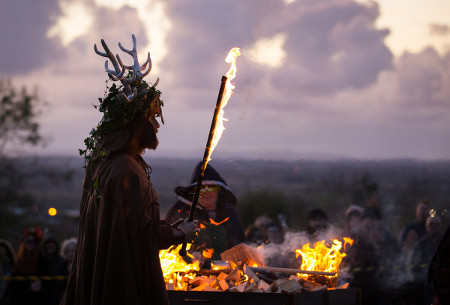
Halloween is a holiday celebrated each year on October 31, a pagan tradition that originated with the ancient Celtic festival of Samhain (pronounced sou-when). In the eighth century Pope Gregory III designated November 1 as a time to honour all saints as the christian religion continued to try to eradicate the Pagan religion. But as with Yule (or Christmas as the christians refer to it) Samhain was too deeply ingrained in the populace and has survived to this day.


Samhain (also known as the festival of fire) marks the transition between the year's lighter and darker halves, the end of summer and the beginning of winter and for the ancient celts Samhain represented the end of one year and the beginning of the next. It was a time for remembering the dead and planning for the year ahead, and also for making winter preparations; crops were harvested, and animals were rounded up from the fields either to be sacrificed or lodged for the winter and used for breeding.

Samhain was considered an auspicious time for the druids to practice divination, since the connection to the spirit world was stronger than usual. The lifting of the veil between the Otherworld and the physical world meant that Samhain was also considered to be a perilous time for the ancient Celts.  Spirits, both kind and malevolent, could act on the human world, the reason why Halloween has the "scary" element behind it today.

After the harvest work was complete, celebrants joined with Druid priests to light a community bonfire using a wheel that would cause friction and spark flames. The wheel was considered a representation of the sun and used along with prayers. Cattle were sacrificed, and participants took a flame from the communal bonfire back to their home to relight the hearth.

Because the pagans believed that the barrier between worlds was breach-able during Samhain, they prepared offerings that were left outside villages and fields and would dress as animals and monsters so that the spirits were not tempted to kidnap them. And carved turnips (which would later become pumpkins) where left outside homes to ward off evil spirits.

Children would also put on costumes and go door-to-door singing songs to the dead with small cakes  given as payment, and tricks might be played on people that were usual attributed to the spirits (which would later evolve into the trick or treat of today).

Indeed, many of the traditions of Samhain have become part of what people now refer to as Halloween and just as with Yuletide, it remains as a legacy of our Pagan ancestors despite the attempts of the Christian religion  to reframe Samhain as a Christian celebration. 

Today many devout christians still follow all of these traditions, keeping the spirit of paganism alive, unaware of the rich history it has or the true meanings behind the symbols themselves.

Saturday, December 05, 2020

Celebrating Christmas

Christmas is almost upon us and the countdown has begun. The Christmas tree, the decorations, the yule log, mistletoe, the Christmas wreath on the door, holly and berries all symbols that many people will recognise for this celebrated Christian festival.


But Christmas has its roots far deeper than Christianity, and all of the symbols used to celebrate it are rooted in Paganism, and in celebrating the Winter Solstice or Yule.

The celebration of Yule was so ingrained in culture that Christianity's attempts to stamp out Paganism led to it usurping the festival of Yule to celebrate the birth of Christ, and Christmas (or Christ Mass) was born. In fact nearly every major Christian festival has its roots in Pagan tradition or directly usurps a Pagan festival for this reason.

So, as you put up and decorate your Christmas tree did you know that the tree was an important symbol in pagan yuletide tradition. Originally, it represented the Tree of Life and was decorated with gifts people wanted to receive from the gods. It was adorned with natural ornaments such as pinecones, berries and other fruit, as well as symbols sacred to the gods and goddess.

And mistletoe which represents the female element (hence the act of kissing under the mistletoe), also holds much importance in pagan yuletide tradition. It was used by Druid priests in special ceremonies during yuletide who believed that its green leaves represented the fertility of the Mother Goddess, and its white berries, the seed of the Forest God or Oak King.

Holly, which represents the masculine element, was often used to decorate doors, windows and fireplaces. Because of its prickliness it was thought to capture or ward off evil spirits before they could enter a home and cause harm. The holly leaves, symbolic of the Holly King, represent hope, and the red berries represent potency.

Many people will burn candles, or place a light candle in their window. Candles were another way to have an eternal flame within the home. They symbolised the light and warmth of the sun and were used to chase away evils and lure back the returning sun/son. They were also an invitation to a stranger that the house would welcome and feed them during the festival period.

Bells, another symbol often hung on Christmas trees are another part of the Pagan yuletide tradition. They were often rung during the Winter Solstice to drive away demons that surfaced during the dark time of the year.

Carolling was also another popular Yule tradition when young children honoured the Winter Solstice with song. They would go through the villages, singing door to door. The villagers, in return, would reward them with tokens and sweets and small gifts which symbolised the food and prosperity given by the Mother Goddess to all her Earthly children.

Even the predominant colours of Christmas, Red, Green, White, Silver and Gold are the colours used in abundance during pagan celebrations of Yule. Red represents the waning Holly King. Green represents the waxing Oak King. White represents the purity and hope of new Light. Silver represents the Moon. Gold represents the Sun/Son.

Today many devout christians still follow all of these traditions, keeping the spirit of paganism alive, unaware of the rich history it has or the true meanings behind the symbols themselves.